Tuesday, June 6, 2017
This Lunar Month is the shortest month of 2017
Thursday, June 1, 2017
बादलों की आवन जावन भी चल रही है।
कहीं कहीं वर्षा रानी भी गरमी से त्रस्त लोगों को छुड़ाने आ पहूंची है ऐसे में आज हम ग्रीष्म त्रिभुज में समाविष्ट हंस पुच्छ (DENEB) नामक तारे की बात करेंगे
अगर रात्रि के नौ दस के करीब एक खूबसूरत ग्रीष्म त्रिभुज देखने मिलेगा।
जो अब एक और मौसम के लिए सुविधाजनक शाम के दृश्य में वापस आने के बारे में है। यह कोई अलग से तारक जुथ Constallation नहीं है परंतु यह एक तीन अलग तारामंडल में आये हुए तीन चमकदार सितारों से बना है। 1.हंस मंडल (Cygnus) के हंस पुच्छ (DENEB), 2. श्रवण मंडल (AQULA) के श्रवण (ALTAIR) और 3. वीणा मंडल (LYRA) के अभिजीत (VEGA) को मिलाकर सुन्दर त्रिकोण बनता है।
अब इस ग्रीष्म त्रिभुज सितारों में से एक जब आप डेनेब (हंस पुच्छ)को ध्यान से देखते हैं, तो आप अंतरिक्ष की एक महान दूरी पर देख रहे हैं। डेनेब की सटीक दुरी अब तक नहीं जानी शकी है, लेकिन स्वीकार्य दुरी लगभग 2,600 प्रकाश-वर्ष मानी गयी है। इससे डेनेब को सबसे दूर के सितारों में से एक के रूप में देखा जा सकता है जो हम अपनी आंखों से देख सकते हैं।
खगोलविदों को डेनेब की दूरी ठीक से क्यों नहीं पता? वास्तव में, इस तारे की दूरी के लिए अलग-अलग अनुमान हैं । अबतक की जानी गयी विकसीत प्रक्रिया की यह एक झलक है, जिसमें खगोलविदों की टीमों या विभिन्न खगोलविद् - उन्नत प्रौद्योगिकियों का उपयोग करते हैं - कुछ साल पहले जो कुछ भी सीखा था, इसमें सुधार करने का प्रयास करते हैं।
पास के सितारों के लिए दूरी खोजने के लिए खगोलविद लोग लंबन(PARALLAX) विधि का उपयोग करते हैं। लेकिन डेनेब पृथ्वी की सतह से सटीक लंबन माप के लिए बहुत दूर है।
डेनेब की दूरी के अनुमानों को विभिन्न तरीकों से प्राप्त किया गया है, जिनमें से कुछ सितारों के विकास के तरीके से संबंधित सैद्धांतिक मॉडल शामिल थे और इनमें से कुछ खगोलविद्दोंने सितारे के साइग्नस OB7 में डेनेब की सदस्यता को मानते हुए दुरी को नापने की कोशिष की थी। डेनेब के लिए सबसे महत्वपूर्ण आधुनिक दूर के माप 1990 के दशक में आया, जिसमें ईएसए (ESA) के पृथ्वी-परिक्रमण करना हिपपारकोस स्पेस एस्ट्रोमेट्री मिशन था। हिपपरकोस ने डेनेब पर एस्ट्रोमेट्रिक डेटा इकट्ठा किया। डेटा के शुरुआती विश्लेषण में लगभग 2,600 प्रकाश-वर्ष की दूरी तय की गई है।
तब से, खगोलविदों के विभिन्न समूहों ने हिपपारकस डेटा का फिर से विश्लेषण किया है। हम जानते हैं कि प्रत्येक आने वाले वर्ष के साथ कम्प्यूटर शक्ति मजबूत हो जाती है, जो विश्लेषण के लिए तकनीकों को बेहतर बनाने में मदद करती है। उदाहरण के लिए, उदाहरण के लिए, 2009 में Peer-Reviewed Journal of Astronomy and Astrophysics में प्रकाशित एक अध्ययन मे विश्लेषण की एक नई विधि का इस्तेमाल किया, जिसके परिणामस्वरूप डेनेब के लिए दूरी तय हुई जो कि व्यापक रूप से स्वीकृत मूल्य का केवल आधा हिस्सा था।
डेनेब की दूरी इतनी महत्व पूर्ण क्यों है? यह खगोलविदों के लिए मायने रखता है क्योंकि - अगर उन्हें नहीं पता कि स्टार कितना दूर है - वे अपने वास्तविक आकार, द्रव्यमान और ऊर्जा उत्पादन की सटीक संख्या प्राप्त नहीं कर सकते।
ईएसए (ESA) के पास अब एक दूसरा एस्ट्रोमेट्रिक सैटेलाइट है - जिसे पृथ्वी के चारों ओर की कक्षा में भेजा गया है जिसे गिया (GAIA) - कहा जाता है। इसका लक्ष्य पहले की तुलना में अधिक सटीकता के साथ सितारों की स्थिति और दूरी को मापना है, ऐसा ईएसए का कहना है ।
सितंबर 2016 में सितारों के नए डेटा आये मगर उसमे देनब के डेटा को रिलीज़ में शामिल नहीं किया गया था। संभवतः डेनेब के लिए एक नई दूरी का अनुमान अप्रैल 2018 के लिए गिया के दूसरे डेटा रिलीज में शामिल किया जाएगा।
और तब हम सटिकता से कह पाएंगे की हम कितनी दूर देख रहे है!!
विज्ञान अविरत विकास कर रहा है
- Narendra Gor
Astronomer Bhuj
+91 9428220472
Written article based on Earth Sky Updates
Narendra Gor
Kutch Amateur Astronomers Club
Balaji Hobby Center
Bhuj
Contact No +919428220472,
http://kutchastronomy.blogspot.com/
Tuesday, November 15, 2016
Conjunction of Moon and Aldebaran
बहोत चर्चित रोहिणी और चन्द्रमा की जोड़ी आज आकाश में नज़र आएगी
Count the time to move Half Degree of Moon…
Narendra Gor ( +91 9428220472 )
Kutch Astronomy Club ~ Bhuj
For Observational Purpose You can watch this from 8:20 to Aldebaran hides behind the Moon…
Then from 9:20 you can restart your observations….
Conjunction of Moon and Aldebaran
बहोत चर्चित रोहिणी और चन्द्रमा की जोड़ी आज आकाश में नज़र आएगी
Count the time to move Half Degree of Moon…
Narendra Gor ( +91 9428220472 )
Kutch Astronomy Club ~ Bhuj
For Observational Purpose You can watch this from 8:20 to Aldebaran hides behind the Moon…
Then from 9:20 you can restart your observations….
Sunday, October 9, 2016
International Moon Observation Night Celebrated
Times of India News Link
Saturday, October 8, 2016
International Moon Observation Night will be Celebrated by Kutch Astronomy Club with the help of NASA
For more information about the InOMN click http://www.lpi.usra.edu/observe_the_moon_night/
Sunday, April 24, 2016
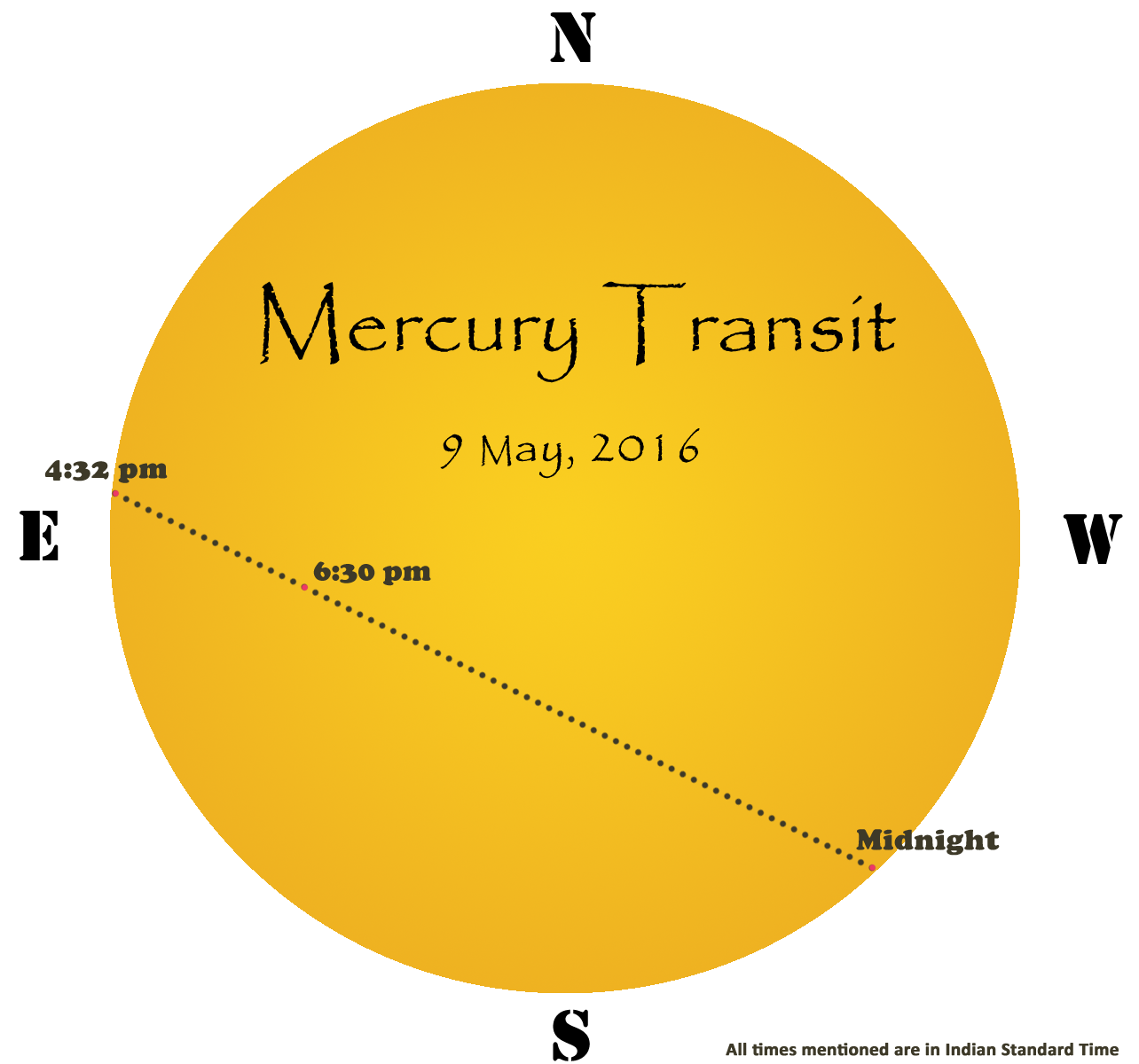
Transit of Mercury – 2016
Observation Program for Mercury Transit for all Astro lovers Date: 09th May 2016 Time 4.00pm to Sunset
1. Bhuj - Place Mundra Relocation Site Char Rasta Prathmik School Bhuj contact no. 9428220472
2. Mandavi- Gurukul School of science Koday Pool Contact. No. 9033387374
Transit of Mercury – 2016
The Sequence of the Transit:
What will we see?
Observational constraints:
| City | Area | Sunset time |
| Srinagar | North | 19:20 IST |
| Imphal | East | 17:48 IST |
| Nagpur | Centre | 18:42 IST |
| Bhuj | West | 19:23 IST |
| Madurai | South | 18:30 IST |
Sun Set time for the Kutch Places
Gujarat Places
Sharing the Transit
Using Telescope or Binoculars:
Links
- Build a Simple telescope [NASA]
- An Easy and Safe Telescope Solar Viewer adapter [IUCAA]
- Build a Sun Funnel to attach to a telescope [Astro Soc of the Pacific]
- How to Look At The Sun [Sky & Telescope Magazine]
- Looking at a Solar Eclipse [Arvind Gupta Toys]
- EclipseWise.com [Fred Espenak - "Mr. Eclipse"]
POEC's ToM activities
- Put out material on transits, and hence eclipses and conjunctions, in the public media. This will help in
(a) combating superstitions and
(b) promote general astronomy knowledge - To get the public, but especially the students to see the transit in some form or the other
Use the transit to get students to do Daytime Astronomy experiments
- Promote observation of this event via workshops or resource material and content for such workshops.
- Arrange, with help from 4-5 locations around the country (observatories + amateurs) for a live broadcast on the web and on TV.
- Bring out a booklet on the history and astronomy of the transit, and how to observe the transit.
- Translate the booklet and put all the pdfs up online for free.
- Ask small telescope owners to register with us for showing the Transit to the public.
- Co-ordiante with media & share the information in relevant circles.
Monday, April 4, 2016
Mercury Transit 9th May 2016 from Kachchh
Question:- What is Transit of Mercury?
we are planning to observe the Transit of Mercury from various places of Kachchh District like Bhuj, Lakhapat, Rapar, Nakhatrana etc
Any interested wants to join or wish helping hand can contact +919428220472
Thursday, March 3, 2016
Geminids proves its Reliability 2015
Geminds proves its Reliability
Astronomer from White Rann desert of Kachchh
Sandhya came from Sweden while Ankita travelled from Bangalore to White Rann only to watch the falling stars. This is the third year we go some dark places to watch the Geminids, we love this dark place and want to visit again and again for Star Gazing both said. Why they prefer Geminds only? Ankita Shrivastav said Geminids are very special and reliable! !!
We enjoyed here for two full night under the dark sky!! She added
Enthusiasts people recorded arround 500 meteors up to 5.30am
In the begenning Narendra Gor informed about the meteors and constellation Gemini was also shown by Him
Mr. Manish Adhiya a Manager welcomed all on behalf of White Rann Campaign
Mr. Nishant showed and demonstrate how to take photographs of heavenly bodies, he practically took some photographs of the meteors
Mr. Aarif and Bhimji member of the star gazing team handled the 6 inch Telescope.
More than 70 Tourists visited the Star Gazing site
Mr. Aakil gave a vote of thanks
Wednesday, January 27, 2016
How you will See Five Planets Align in the Morning Sky
How to See Five Planets Align in the Morning Sky
If you look at the right time, the moon will also be a part of the cosmic parade.
Skywatchers will soon have a rare opportunity to view five bright planets in the morning sky.
Over the next two weeks, five planets will line up for a cosmic dance that will dazzle skywatchers all over the world.
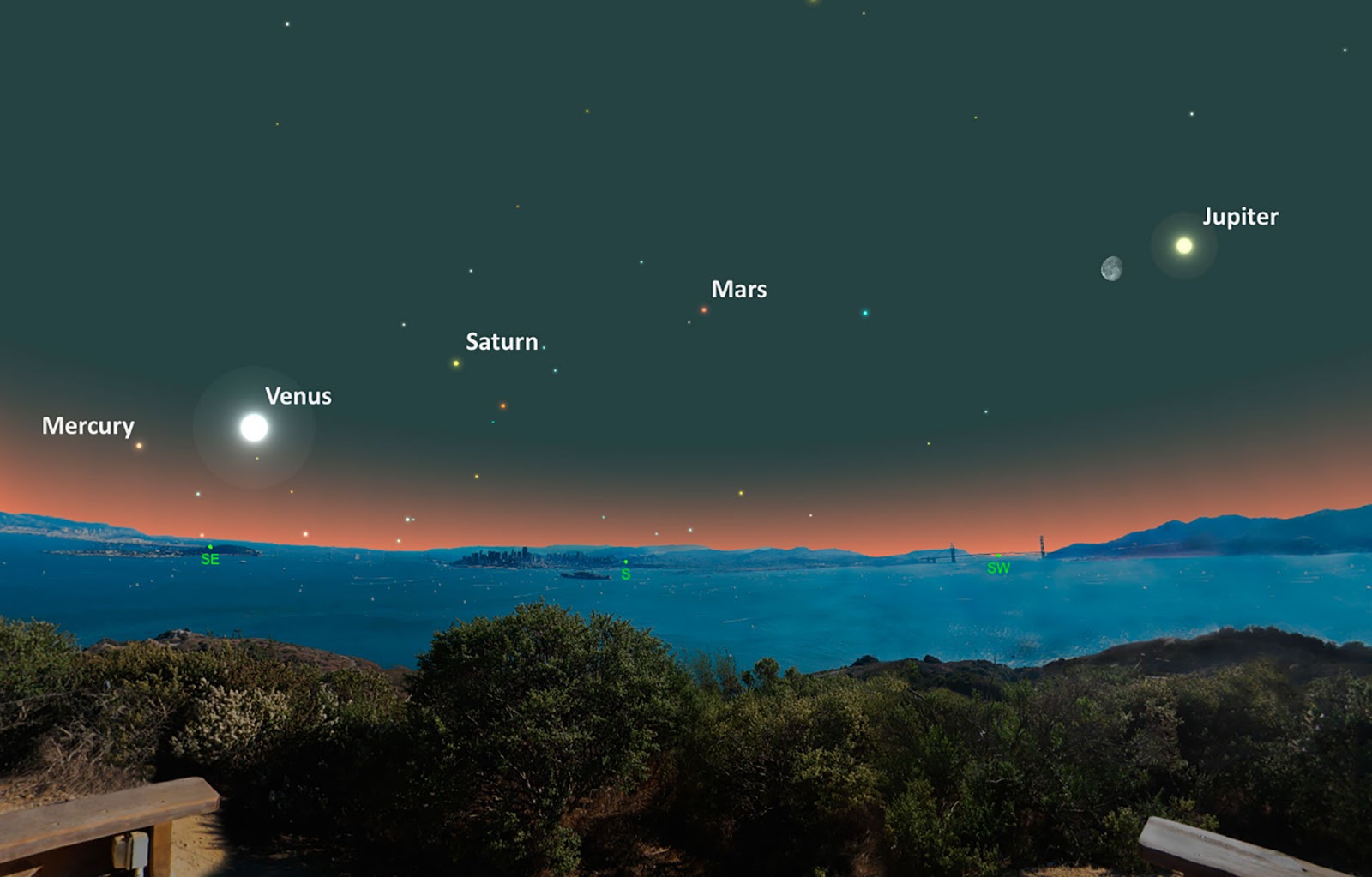
Mercury, Venus, Mars, Jupiter, and Saturn are aligning for the first time in over a decade, and there’s no need for telescopes or binoculars to see the event, since all five planets will look like bright stars in the morning twilight.
On January 28, the moon will join the five visible planets in the dawn sky, first stopping by Jupiter, high in the sky
While many early risers may have noticed some of the planets days ago, the best time to look will be from Saturday, January 23 through the end of the first week of February.
During those days, there will be a narrow window in which to catch Mercury in line with the others. If you look too early, it’ll be hidden below the horizon. If you look too late, it’ll be washed out by sunlight. The prime time to see it and the other planets will be about 30 to 60 minutes before local sunrise. Since Mercury will be very low in the southeast
(the same direction as the rising sun), make sure to find a viewing spot with a clear view of the horizon.
Venus, the brightest of all the visible planets, will appear to the upper right of Mercury.
On January 22nd, the two planets will be separated by about 10 degrees, equal to about the width of your fist at arm’s length.
By February 10 the two planets will be less than 5 degrees apart, or about the width of your three middle fingers at arm’s length.
The planetary alignment visible in Earth’s skies is due to the relative positions of the planets in their orbits around the sun.
The other three planets will be further to the upper right of Venus. Yellow-colored Saturn, a bit dimmer than Venus, comes first. If you have a telescope, this will be a good time to train it at Saturn and marvel at the planet’s magnificent rings and brighter moons.
Mars will appear to Saturn’s right, looking bright orange, with Jupiter off to its far upper right, completing the alignment high in the sky. Binoculars will show off Jupiter’s four largest moons, which were first seen by Galileo in 1609 with the newly invented telescope.
The entire lineup of planets spans some 110 degrees—more than half of the locally visible skyline.
The planets’ simultaneous visibility in one part of our sky is due to their positions in their respective orbits relative to Earth and the Sun.
By February 6, the thin crescent moon will pose with brilliant Venus and Mercury low in the southeast at dawn.
As an added bonus, the moon will play cosmic hopscotch, jumping from one planet to the next, offering an amazing photo opportunity for sky hounds.
The moon will first pair up with Jupiter on January 27 and 28, then it will park itself next to Mars on February 1,
Saturn on February 3, Venus on February 5, and finally Mercury on February 6.
If you miss this alignment, your next chance to so easily see a grand parade of five planets will be in July 2020.
Clear skies!
For more information
Whatsap 9428220472
Narendra Gor
Kutch Astronomy Club
✨